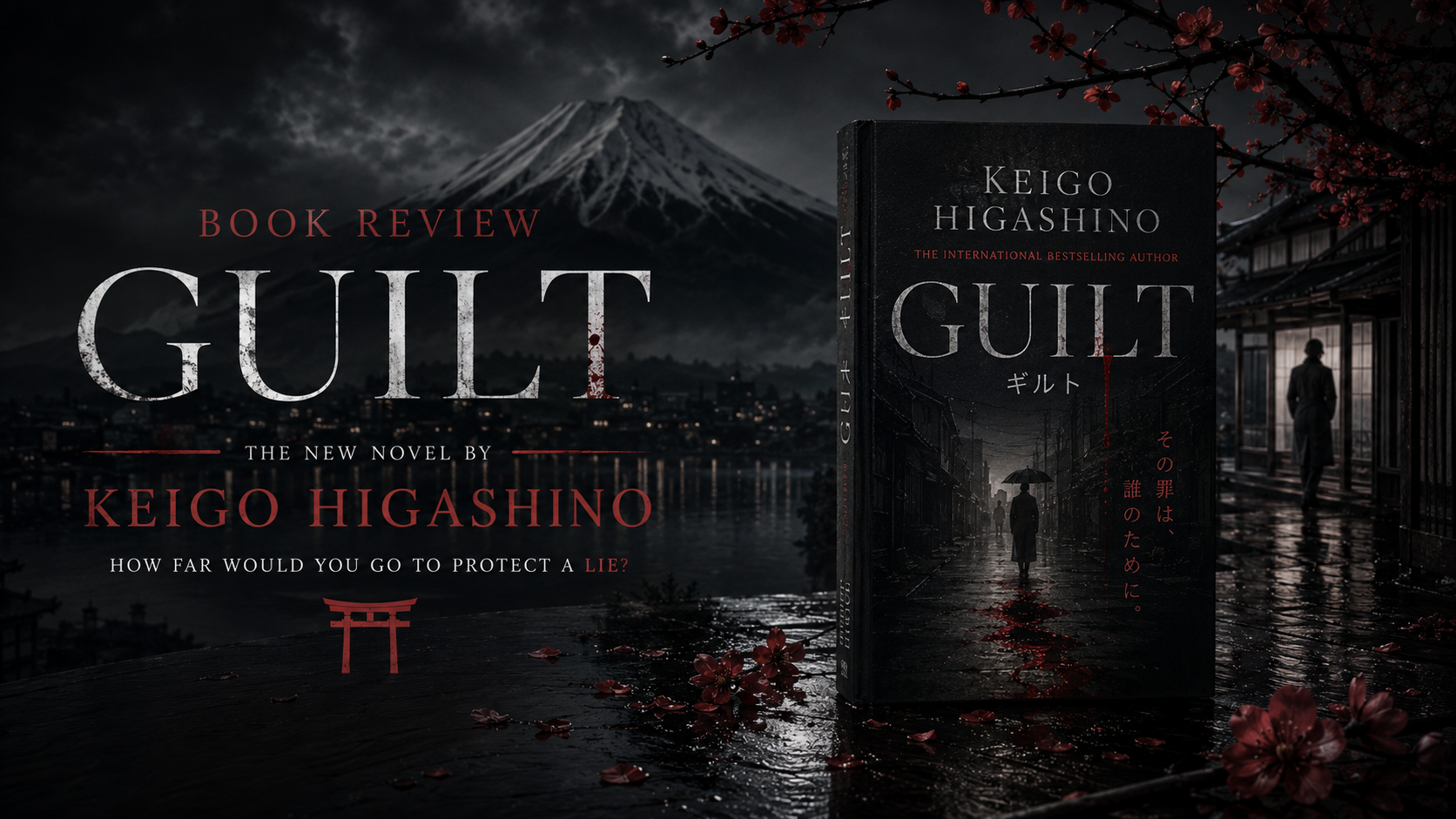

Keigo Higashino Does Something You Won’t Expect
Keigo Higashino opens Guilt exactly the way you’d want him to. There’s a murder. There’s a new detective, detective Godai and because he’s brand new to Higashino’s universe, you have no template for how he thinks or how he works. That unfamiliarity is actually exciting. Everything is in play. Nothing is predictable yet.
So far, so Higashino.
Then, around page 80, someone confesses.
That’s the moment Guilt announces itself as something genuinely different. In most thrillers, a confession that early would be the beginning of the end. Here, it’s the beginning of the real mystery. The confession rings false, to Godai, to the victim’s family, to the reader, and from that point on, the book becomes something stranger and more interesting than a standard whodunit.
The Middle Section Is a Problem
Here’s where the honest review gets uncomfortable. Pages 180 to 300, roughly the second quarter of this ~500-page book (kindle) are slow. Not “takes a moment to breathe” slow. Lethargic. The kind of slow where you feel the characters circling the same ground, picking up on clues at a pace that’s significantly behind what the reader has already worked out.
Because of this, the tension bleeds out exactly when it should be building. For anyone who’s read Higashino before, this stands out immediately. His best work moves with a kind of quiet urgency, you’re always slightly off balance, always slightly behind. In Guilt, that mid-section reverses it. You’re ahead. And waiting.
That said, it’s important to put this in context. This is the slowest Higashino has ever written, but it’s still Higashino. The prose is controlled. The structure is deliberate. The question is whether that deliberateness serves the story, and in this stretch of the book, it doesn’t quite.
The Ending Earns It
The last 150 pages are where Guilt justifies everything that came before it, including the slow middle.
Higashino plants details early in the book that seem completely throwaway at the time. A random fact here. An innocuous observation there. The kind of details you register and immediately dismiss as scene-setting. When those details come back in the final act, connected to something much larger, it lands. Not with a crash, with the quiet precision Higashino does better than almost anyone else writing in this genre.
Additionally, the moral weight of the book, what guilt actually means, who carries it, and why, snaps into focus right at the end. That’s the thematic payoff. It doesn’t redeem a broken book, because Guilt isn’t a broken book. It redeems a slow one.
Watch the full review above and subscribe to FilmyFool on YouTube for more book and film reviews every week.
Where Guilt Fits in the Higashino Reading Order
If you’re coming to Guilt without having read Higashino before, stop. Don’t start here.
Start with The Devotion of Suspect X. It’s the book that established Higashino’s international reputation, and for good reason, it’s a masterclass in misdirection. Indian readers may recognise the story from Jaane Jaan, the 2023 Netflix film directed by Sujoy Ghosh and starring Kareena Kapoor Khan, Jaideep Ahlawat, and Vijay Varma. The film is worth watching. However, the book is a significantly richer experience, deeper in character, more precise in its construction.
From there, Salvation of a Saint is the next essential read. Then Malice, which is Higashino at his most literary, a book that proves you can write with real depth of character inside a thriller structure without sacrificing pace or tension. Newcomer and Midsummer’s Equation round out the five.
For more thrillers, check out the FilmyFool review of Career of Evil by Robert Galbraith, and The Last Devil to Die by Richard Osman.
The Verdict
Guilt lands at about 3.2 to 3.5 out of 5 for me, and that number tells you something interesting. The start is excellent. The end is genuinely rewarding. The middle costs it at least a full point on its own.
In contrast to Higashino’s best work, Guilt doesn’t sustain its momentum. But in contrast to most thrillers published this year, it’s still a cut above. For this reason, the recommendation is conditional: if you’ve already read the five books on that list, Guilt is worth your time. If you haven’t, build up to it.
Silent Parade remains the one Higashino that genuinely didn’t work for me. Guilt is nowhere near that territory. It’s an imperfect book from a writer who raises the floor so high that even his lesser work clears it.