
A sci-fi thriller set entirely in a forest
Sambhavam: Adhyayam Onnu, which translates to Incident: Chapter One, just landed on Jio Hotstar. And honestly, it has flipped my mind. I keep coming back to Malayalam cinema’s craft, and this film is yet another reminder of what this industry can do with almost nothing.
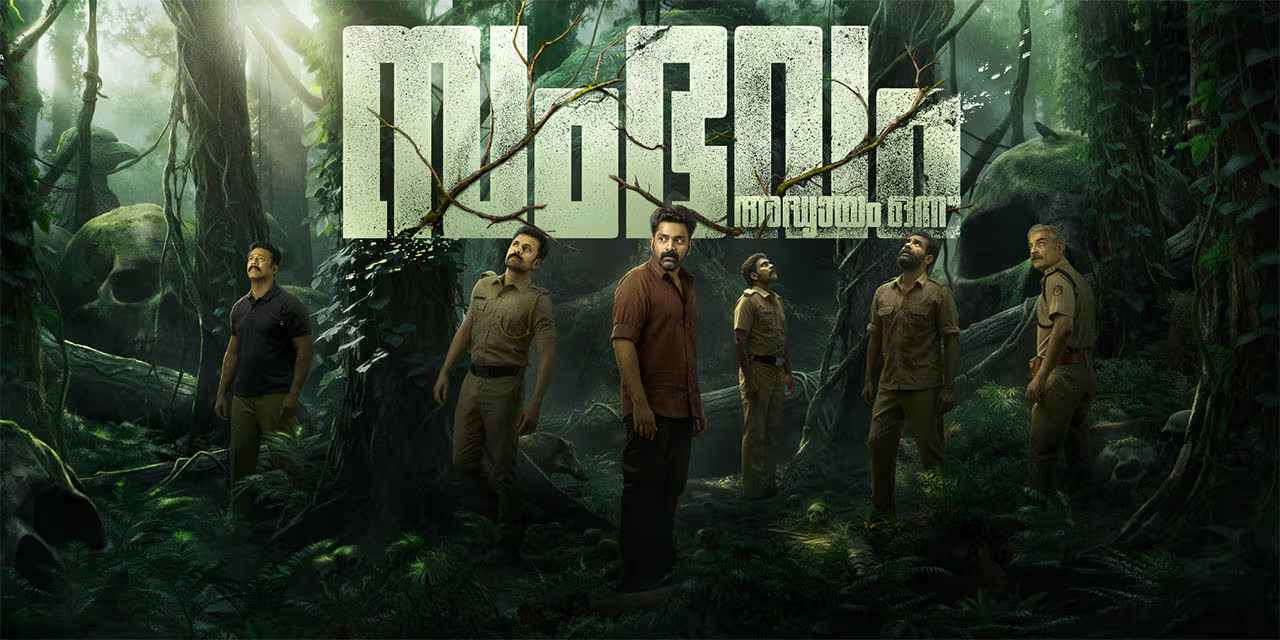
The premise sounds straightforward on paper. A section of forest has been cordoned off by forest officers. Nobody is supposed to go past that point. A group of police officers enters anyway. Strange things start happening. That’s it. That’s the setup.
I’m not going to spoil what happens next. If this premise interests you even slightly, stop reading and go watch it. However, I do want to talk about why this works as well as it does, because the execution here is something special.
The direction is the real star
Jithu Satheesan Mangalathu directs this film, and the job he’s done is incredible. This is a non-linear, scrambled screenplay. As a result, it’s the kind of structure that falls apart in lesser hands almost instantly. Timelines that jump around can confuse an audience or feel like a gimmick. Here, none of that happens.
What struck me most is the simplicity behind it. There’s no elaborate set design propping this film up. The film is set almost entirely in a forest. Trees, mostly. And yet, the direction makes every single frame count. That’s a much harder thing to pull off than throwing money at a production.
The one major exception to that minimalism is a statue and a temple that appear early in the film. The first time that frame breaks onto the screen, something shifts. You immediately sense that something is off, and from that point, the film has you.
A background score that disappears into the film
I want to spend some time on the score, because this is one of the most quietly impressive aspects of the film. Most background scores aim to be memorable on their own. You hum them later, you recognize them instantly, they become an identity.
This score does the opposite. It doesn’t try to stand apart from the film. Instead, it becomes part of the film itself, woven into every important moment and every important frame. It avoids the typical loud, amped-up style that’s become common in Tamil cinema and has bled into a lot of Bollywood as well, the kind built for mass entrance scenes and star moments.
For this reason, the score here feels different. It’s restrained, it’s purposeful, and it adds to the experience instead of demanding attention for itself. This is the kind of work that should genuinely be studied.
A screenplay built for non-linear storytelling fans
If you’re someone who loves non-sequential storytelling, this film is for you. I’ll admit my bias here. I’m a sucker for non-linear screenplays, in any medium, whether it’s film, series, comics, or books. When done well, this kind of storytelling creates an inherent intrigue that linear narratives just can’t replicate. It’s the same reason I keep coming back to stories built around repeating timelines and shifting perspectives, or shows like Dark that thrive on the audience piecing together a puzzle rather than being handed one.
That said, this isn’t a film built for viewers chasing a typical blockbuster experience. The first half moves slowly, and a lot of people will feel lost during it. Stick with it anyway. The writing pulls you in gradually, then drops anchor points that jolt you awake, almost like the film is reminding you to pay attention. If you’ve watched something like Gyaarah Gyaarah, you’ll recognize this rhythm of disorientation followed by clarity.
By the time those anchor moments land, you’re so deep into the characters that you start reacting alongside them. That’s a difficult thing for any film to achieve, and this one does it.
Performances that never overreach
The cast deserves real credit here too. Every actor stays grounded in the world of the film, and you’ll rarely catch an overreaction or underreaction anywhere. Considering how far-fetched the central premise actually is, that’s not a small achievement.
In a story like this, it would be easy for performances to tip into theatrics. Instead, every reaction feels calibrated and earned, which keeps the film believable even when the events on screen are anything but ordinary.
An unexpected comic book parallel
Here’s something I didn’t expect going into this film. While watching it, I kept thinking about a comic book I reviewed a while back, Technicolour Lovers, one of Black Sheep’s first releases alongside Yali.
Both stories are rooted in folklore and regional religious mythology. Both use a forest as a central narrative element. There’s a recurring thread connecting the two, not an obvious easter egg, but more of a feeling and tone. The comic leans more atmospheric and monochrome, while the film carries a slightly more modern sensibility, but the underlying mood and the way incidents unfold feel related.
If you enjoyed this film, I’d genuinely recommend picking up Technicolour Lovers. And if you’ve read the comic already, this film might land even harder for you.
Who should watch this, and who should skip it
This film is for you if you genuinely enjoy non-linear storytelling, the kind where the timeline scrambles and you have to piece things together as you go. If that’s your thing, this is one of the better examples of it in recent Malayalam cinema. It’s also for you if you appreciate restraint, both in performance and in production design, because this film leans on neither star power nor spectacle.
However, if you’re looking for a fast-paced, conventional thriller with a clear linear build, this might test your patience. The first half deliberately withholds context, and a lot of viewers will feel disoriented before things click. That’s not a flaw, but it’s worth knowing going in. If slow-burn, puzzle-box narratives frustrate you more than they intrigue you, this one might not land the way it did for me.
Final verdict
Sambhavam: Adhyayam Onnu is hallmark Malayalam filmmaking. Fabulous writing, simple aesthetics, and a cast that’s locked in across the board. The first half asks for patience, but the payoff is absolutely worth it.
This is the kind of film I’ll be recommending for a long time. Watch the full review above and subscribe to FilmyFool on YouTube for more breakdowns like this one. Sambhavam: Adhyayam Onnu is streaming now on Jio Hotstar.